
Traditional French doors and modern sliding doors compared side by side
Blog · Comparison Guide
French Doors vs Sliding Glass Doors: Which Suits Your Home?
French doors and sliding glass doors solve the same basic problem — connecting your home to the garden — in fundamentally different ways. One swings; the other slides. The choice affects how you use the room, how much furniture you can place near the opening, how much natural light reaches the interior, and — for period properties — whether the door suits the character of the house. Here is a practical, repairer's-eye comparison to help you decide, whether you are planning a new installation or weighing the merits of the doors you already have.
French vs Sliding: At a Glance
| Criteria | French Doors | Sliding Doors |
|---|---|---|
| Opening style | Hinged — both leaves can open inward or outward. Swing arc requires clear floor space | Panels slide horizontally on tracks. Zero clearance required in front of the door |
| Usable opening | Wide clear opening when both leaves are open — similar to bifold effect on a smaller scale | ~60-65% of structural opening. One or two panels slide behind fixed panes |
| Light & views | Two narrower panes with a central meeting stile. More frame, less uninterrupted glass | Larger uninterrupted panes. Cleaner sightlines and more glass area per metre of opening |
| Space required | Swing arc occupies floor space. Furniture cannot be placed within the door's sweep | Zero floor space needed. Ideal for smaller rooms or tight layouts |
| Security | Modern multipoint locks with shoot bolts are very secure. Older doors may only have a single latch | Hook locks engage into the frame. Resistant to being levered open when correctly fitted |
| Period home fit | Excellent — suits Victorian, Georgian and Edwardian properties. Traditional aesthetic | More modern look. Can look out of place on a period property unless carefully specified |
| Repairability | Hinges, locks, handles and seals all individually replaceable without replacing the door | Rollers, tracks, locks and seals all individually replaceable. Mechanically simple |
Space & Opening: The Swing vs Slide Trade-Off
The most practical difference between French and sliding doors is what they demand from your room. French doors need clear floor space to swing open — typically a 900mm to 1,200mm arc in front of each leaf. That means no sofa, no dining table, no sideboard can sit within the door's sweep. In a compact kitchen-diner or a room where every square metre of floor space is spoken for, that swing arc can be a dealbreaker. Sliding doors, by contrast, glide parallel to the wall. They consume zero floor area, which means you can push furniture right up to the door — an underrated advantage in smaller UK homes.
On the other hand, French doors — when both leaves are open — give you a wider clear opening than a same-width sliding door. A pair of French doors on a 1,800mm opening gives you essentially the full width when open, whereas a sliding door on the same opening typically leaves about 1,100mm to 1,200mm of actual walk-through space. For moving large items in and out — furniture, appliances, potted plants — French doors have the edge. For everyday use, however, most people only open one leaf of a French door, which gives a similar passage width to a sliding door but without the convenience of a slide.
There is also the wind factor to consider. A French door left open on a breezy day can slam — potentially damaging the hinges, the frame, or the glass. A sliding door simply stays where you left it. In exposed locations — coastal properties, hilltop homes — this is a meaningful practical difference that gets overlooked in showroom comparisons.
Light & Views
For a given opening width, sliding doors give you more glass and less frame. A sliding door's structural frame runs around the perimeter only, with a single vertical interlocking stile where the moving panel meets the fixed panel. French doors have a frame around every leaf plus a central meeting stile where the two leaves close together — which adds up to noticeably more frame and noticeably less glass. The difference matters most when the doors are the main source of natural light for a room. If you are choosing between the two for a north-facing kitchen extension that needs every lumen it can get, sliding doors win on light transmission.
Views are similarly affected. Sliding doors' larger glass panes, uninterrupted by heavy central frame sections, give a cleaner picture-window effect. French doors frame the view in two narrower vertical panels — which can look charming in the right context but does not deliver the same expansive connection to the garden.
Security
There is a persistent belief that French doors are less secure than sliding doors because they "could be kicked in." This is largely outdated. Modern French doors — particularly those manufactured in the last 15 to 20 years — are fitted with multipoint locking systems that engage shoot bolts into the top and bottom of the frame plus multiple hook or roller cams along the locking edge. When properly locked, a modern French door is very resistant to forced entry. Sliding doors use hook locks that engage into the frame, which resist levering — the most common attack method on sliders — effectively when correctly installed and maintained.
The real security variable is not French versus sliding; it is the quality and condition of the lock. A worn lock, regardless of door type, is a vulnerability. If your existing door's key is stiff, the handle is loose, or the lock does not engage cleanly, get it assessed. A lock replacement or French door repair can restore full security without replacing the door. And if you have an older door with only a single central latch — common on pre-2000 French doors — upgrading to a modern multipoint lock is a worthwhile investment.
Period Homes & Character
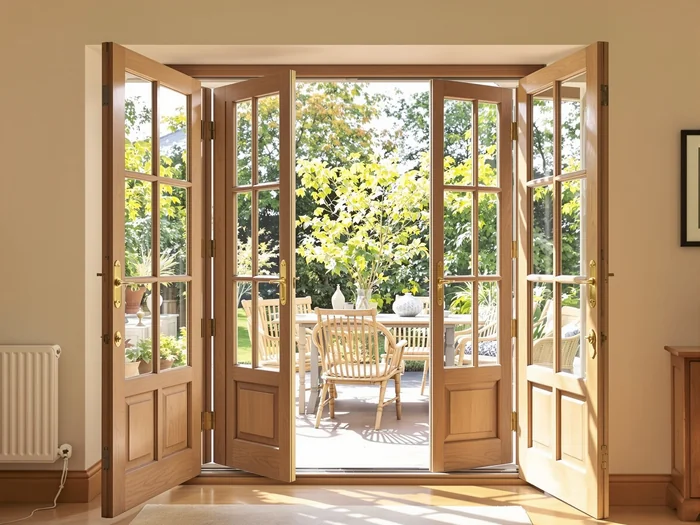
French doors opening outward into a bright garden room
French doors and period properties are a natural fit. Victorian, Georgian, and Edwardian homes were designed with hinged external doors, and a well-chosen pair of timber French doors in a period-appropriate style sits comfortably within the architectural language of these houses. Sliding doors — with their horizontal lines and minimal framing — read as distinctly modern, and on a Victorian terrace or a Georgian townhouse they can look visually jarring. This is not just an aesthetic preference; in conservation areas and listed buildings, the door type and material may be constrained by planning requirements, and French doors in timber are far more likely to be acceptable than aluminium sliders.
That said, period French doors do age, and the common faults are well understood: timber swelling in damp weather causing the leaves to stick, worn hinges causing the door to drop and scrape the threshold, degraded draught seals, and locks that have seen decades of use. Our French door repair specialists are experienced with period timber doors and can assess whether restoration — usually the best route for a solid original door — will restore function, or whether new doors are genuinely needed.
If you own a period property and the doors are original, preserving them is almost always the right move — both for the character of the house and for its value. A repair that costs a few hundred pounds can save a door that would cost thousands to replicate in quality timber. For more on when repair beats replacement, see our cost guide and the energy efficiency guide for draught-proofing older doors.
Converting From One to the Other
Some homeowners ask whether they can convert an existing sliding door to French doors — or vice versa — without major building work. The honest answer: it depends on the opening, but it usually involves more than a simple door swap. Sliding doors sit on a bottom track that is typically recessed into or mounted on the threshold, and the frame is designed to carry weight vertically rather than on side hinges. French doors, by contrast, are side-hung and the frame must support the weight of each leaf on hinge fixings. Converting between the two often requires adapting or replacing the frame entirely, checking whether the lintel above the opening is adequate for the different load path, and making good the surrounding masonry and plasterwork.
The cost of conversion is generally higher than a like-for-like replacement, and in some cases — where the opening needs structural alteration — significantly so. If you are considering converting, our installation service includes a survey that assesses the viability and cost of the work before you commit. Do not assume it is a straightforward swap — get a specialist to look at the opening first.
Mid-article takeaway: Most French and sliding door faults — sticking, draughts, loose handles, failed locks — are repairable without replacing the door. Before you spend thousands on new doors, get a specialist assessment. A repair might cost a tenth of the replacement and extend the door's life by a decade.
Get a Free AssessmentFrequently Asked Questions
Are French doors or sliding doors more secure?
Both French doors and modern sliding doors are secure when fitted with a good-quality multipoint locking system. French doors typically have shoot bolts at the top and bottom of the passive leaf plus a multipoint lock on the active leaf. Sliding doors use hook locks that engage into the frame, which are resistant to being levered open. Neither door type is inherently 'more secure' — the key factor is the quality of the lock mechanism and the installation. A cheap lock poorly fitted is a vulnerability regardless of door type. If your existing door's lock is failing, a specialist can usually replace the lock mechanism without replacing the entire door.
Can you convert a sliding door to French doors?
Converting a sliding door opening to French doors is possible but involves structural work — the opening may need to be adjusted because French doors require a different frame configuration. The existing sliding door track and frame would need to be removed, and the new French door frame installed, which may involve minor masonry work, lintel checks, and making good around the opening. It is not a simple 'swap' and costs more than a like-for-like replacement. Similarly, converting French doors to sliding doors requires structural adjustment. If you are considering this, get a specialist survey before committing — the structural implications can be more involved than they first appear.
Which door type is easier to repair — French or sliding?
Both door types are highly repairable, and the ease of repair depends on the specific fault rather than the door type. French door repairs often involve hinge adjustment, lock replacement, or draught-proofing — all straightforward for a specialist. Sliding door repairs commonly involve roller replacement, track cleaning, and lock or gearbox work. The key advantage of both types is that individual components — hinges, rollers, locks, handles, seals — can be replaced without replacing the entire door. Neither type is significantly harder or more expensive to repair than the other. What matters more is whether your specific door uses standard or proprietary parts — and a good specialist can advise on that during an assessment.
Need advice on your French or sliding doors?
Whether you need a repair, an honest opinion on replace vs repair, or a quote for new doors, our vetted local specialists can help.
Get a Free Quote