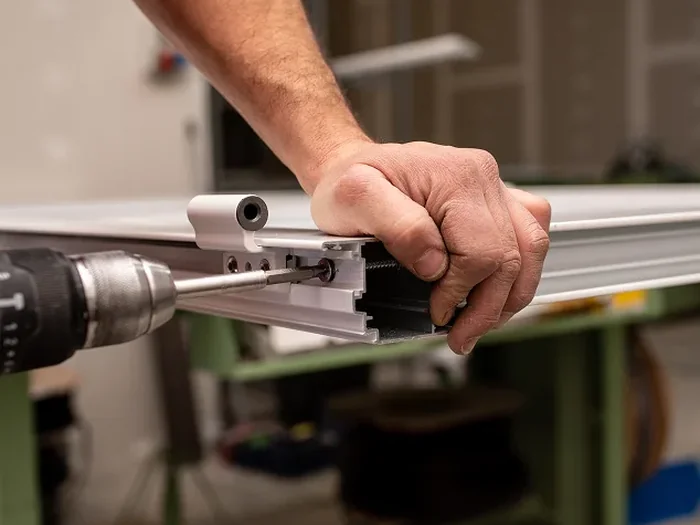
Replacing worn rollers — the single most transformative sliding door repair
Sliding Door Roller & Track Replacement
Roller replacement is the single most transformative repair you can make to a sliding door. If your patio door has been getting progressively harder to slide — you have to put your shoulder into it, it grinds across the track, or it jumps and catches mid-way — the rollers are almost certainly worn out. A sliding door with fresh rollers glides along its track with fingertip pressure. It is the difference between a door you dread using and one you barely notice.
The rollers — the small wheels that carry the full weight of a sliding door panel — are under constant load. Every time the door slides open or closed, those wheels rotate under pressure. Over years of daily use, the bearings inside the roller degrade, the wheel surface flattens, and the roller housing settles lower into the track. A 30-kilogram door panel becomes harder and harder to move until one day it seizes completely or jumps off its track. Our roller replacement service restores that smooth, effortless glide — and because our specialists carry a wide range of roller types on their van, many jobs are completed in a single visit.
We replace rollers on all frame materials — uPVC, aluminium, and timber — across sliding patio doors, bifold doors, and tilt-and-slide systems. Whether your door has two small tandem rollers per panel or a single heavy-duty adjustable assembly, our specialists know how to identify the right replacement, remove the door panel safely, fit the new rollers, and adjust them so the door sits at the correct height and slides evenly.
Roller Replacement Service
The process is straightforward for the homeowner, even if it is technically demanding for the specialist. The specialist arrives, assesses the door, and confirms what the problem is — in most cases, it is exactly what you suspect: worn rollers. They lift the door panel out of its track (a careful operation on heavier doors, often requiring two people), remove the old rollers, fit the new ones, adjust the height so the door sits correctly and slides evenly, and test the door thoroughly before confirming the job is done.
Most roller replacement jobs take between one and two hours from start to finish, depending on the number of panels, the door weight, and whether any track cleaning or minor track repair is also needed. The cost is determined by the number of rollers being replaced, the roller type, and the door configuration — a single roller pair on a lightweight uPVC door is at the lower end; multiple roller assemblies on a heavy triple-panel aluminium door are at the upper end. As always, you get a clear quote before any work begins.
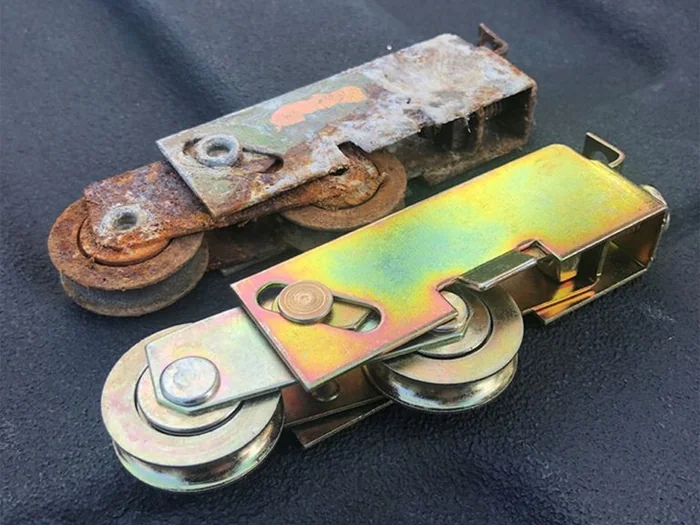
Old vs new — a flat-spotted roller next to a fresh tandem replacement shows why your door drags
Signs Your Rollers Are Worn
From grinding noises to doors that drag — here are the unmistakable signs that your sliding door rollers need replacing.
Grinding or scraping noise when sliding
A metallic grinding sound usually means the roller bearings have failed and the wheel is no longer rotating smoothly. The noise may be intermittent at first and then constant. By the time grinding is audible, the roller wheel is almost certainly damaged and needs replacement.
Door drags or requires force to move
This is the classic worn-roller symptom. As the roller wheel flattens or the bearings seize, the door panel sinks slightly and the bottom edge or the roller housing itself begins to drag on the track. The door feels progressively heavier until it becomes a two-handed effort to slide it. This is usually the point at which homeowners contact us.
Door jumps or catches on the track
If the door hits a particular spot on the track and jumps or catches, the track surface may be worn or the roller may have developed a flat spot that catches at the same point in the rotation. Both the roller and the track may need attention — see the track section below.
Visible flat spots on the roller wheels
If you can lift the door panel slightly — or tilt it inwards if it is a tilt-and-slide door — and inspect the rollers, flat spots are the clearest sign that replacement is needed. A healthy roller has a smooth, round profile. A flattened section means the wheel has stopped rotating freely at some point and has been dragged across the track instead.
Metal shavings or debris on the track
Fine metal particles or plastic fragments on the track are a sign that the roller or the track surface is wearing away. If you see this, do not ignore it — the wear accelerates once the protective coating on the metal is breached.
Types of Sliding Door Rollers
If you have been searching for sliding door replacement rollers or sliding glass door wheels and are trying to understand what type you need, this guide will help. Rollers vary by wheel material, housing design, and adjustment mechanism — and fitting the wrong type can cause alignment problems or track damage.
Single vs Tandem Rollers
Single-wheel roller assemblies carry the door weight on one wheel per assembly. Tandem (or double) roller assemblies use two wheels mounted on a single housing — one behind the other — to spread the load and improve stability. Tandem rollers are common on heavier doors and bifold systems. The number of roller assemblies per door panel also varies: lighter uPVC doors may have just two assemblies, while heavy aluminium sliders often have four or more.
Steel vs Nylon Wheels
Steel rollers — typically stainless steel or zinc-plated — are more durable and are the correct choice for heavier doors and high-use situations. Nylon rollers run more quietly and are gentler on aluminium tracks, making them a good choice for lighter domestic doors. The specialist will match the roller material to your door type and track material. Fitting steel rollers on a soft aluminium track without the correct profile can accelerate track wear, which is one of the risks of a generic roller replacement.
Adjustable vs Fixed Housings
Many roller assemblies have an eccentric cam mechanism that allows the roller height to be adjusted — this is what the specialist uses to set the door at the correct height and ensure it slides evenly along the track. Fixed (non-adjustable) housings are simpler and found on some older doors. If your door has adjustable housings, the adjustment capability is a sign of a quality installation and should be used during roller replacement to get the door sitting perfectly.
How to Identify Your Rollers
Identifying roller type without removing the door is difficult because most of the roller assembly is hidden inside the door's bottom rail. The easiest approach is to tilt the door panel inwards (if it is a tilt-and-slide type) or lift it slightly to photograph the bottom edge. A specialist can also identify the rollers by removing the door panel — which is what happens during the assessment visit. If you want to research beforehand, look for a manufacturer name on the door frame or handle; this often helps narrow down the roller type.
Track Repair & Replacement
The rollers run on a track, and when the rollers fail, the track often suffers too. A worn roller can gouge the track surface, creating grooves or flat spots that make even new rollers catch. Debris trapped in the track — small stones, compacted dirt, pet hair — acts as an abrasive and accelerates wear on both rollers and track. In many cases, a thorough track clean and light surface dressing is all that is needed alongside roller replacement. In more severe cases — deep grooves, corrosion, or a track that has been bent by a door that was forced while off its rollers — track repair or replacement may be necessary.
Track caps (removable strips that sit on top of the main track and are designed to be replaced) are used on some door systems, and these are a straightforward swap. For doors without replaceable caps, the specialist can sometimes dress the track surface — smoothing out minor scratches and burrs — to give new rollers a clean running surface. Full track replacement is a more involved job and is only recommended when the track is too damaged for repair. The specialist will always assess the track condition during the roller replacement visit and advise accordingly.
Why DIY Roller Replacement Often Goes Wrong
We see the results of DIY roller replacement attempts regularly — and we say this not to scaremonger but to be honest about what the job involves. A sliding door panel is heavy. A standard uPVC patio door panel weighs around 25 to 35 kilograms; a large aluminium slider can weigh more than 60 kilograms. Lifting it out of the track safely requires the right technique and often a second pair of hands. Dropping a door panel is dangerous and will damage the door — potentially beyond repair.
The second common pitfall is ordering the wrong rollers. Roller dimensions — wheel diameter, housing width, axle type, adjustment range — vary between door manufacturers, and a roller that looks similar online can be several millimetres out on a critical dimension. A roller that is too tall raises the door so it catches on the top track. One that is too short leaves the door dragging on the bottom track. One with the wrong axle diameter does not fit at all. Our specialists have seen every permutation and know how to identify the right part the first time — which is why our sliding door repair service often receives calls from homeowners who have already spent money on parts that did not fit.
For a related service that often accompanies roller replacement — particularly on doors where the lock has also been affected by the door dropping — see our lock replacement page.
Roller Replacement Near You
Searching for "sliding glass door roller replacement near me" or "rollers for sliding patio doors" because your door has become a struggle to open? Our matching service connects you with a vetted local specialist who carries common roller types and can reach you quickly. Tell us your postcode, describe your door and the symptoms, and we will put you in touch with the right specialist for your area.
Our network covers 14 major UK cities — Manchester, Birmingham, Leeds, Liverpool, Bristol, Sheffield, Newcastle, Nottingham, Leicester, Southampton, Brighton, Glasgow, Edinburgh, and Cardiff — plus their surrounding areas. London is served by our sister site, sliding-door-repair-london.uk.
Frequently Asked Questions
Common questions about this service from UK homeowners.
Available Across the UK
Our network of independent specialists covers 14 major UK cities and their surrounding areas — from Glasgow to Brighton, Cardiff to Newcastle.
In London? Visit our dedicated London specialists at sliding-door-repair-london.uk
Restore Smooth Sliding Today
Worn rollers replaced by vetted local specialists — free quotes, no obligation.