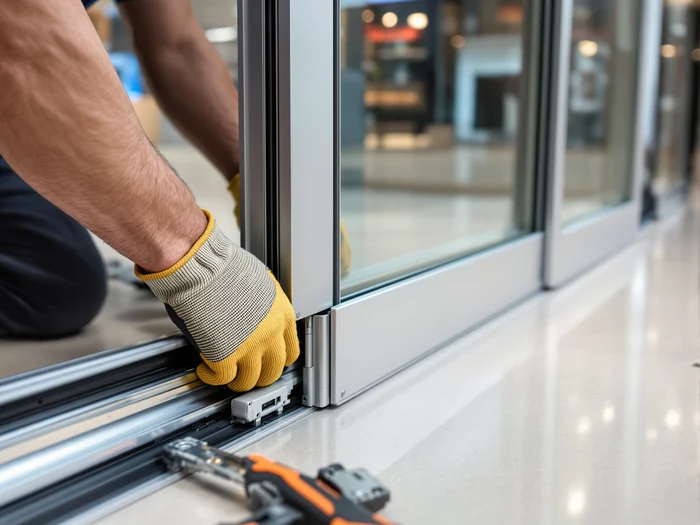
Repairing a commercial shop front door — downtime costs money
Commercial Sliding Door Repair
For businesses, a broken sliding door is not just an inconvenience — it is a direct cost. A shop front door that will not open means lost trade. An office entrance door that will not close means security and access issues. An automatic door that has failed means staff redeployed to manually manage entry. Our commercial door repair service connects businesses with vetted local specialists who understand that commercial doors cannot wait weeks for a repair.
We cover the full range of commercial door systems: manual shop front sliding doors, automatic sensor-activated doors, heavy-traffic aluminium sliders in retail and hospitality settings, warehouse and industrial sliding doors, and secondary glazed entrance doors. Our specialists work with property managers, business owners, retail operations teams, and facilities management companies across 14 UK cities.
Every commercial repair starts with a diagnosis and a clear quote. For businesses with multiple doors or multiple sites, we can arrange planned maintenance schedules to prevent failures rather than just responding to them. Use the contact form to request a business quote, and we will match you with the right specialist for your sector and location.
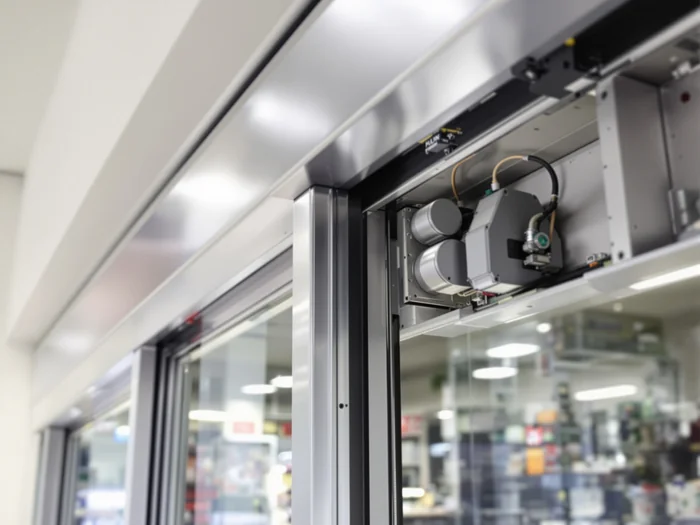
Inside an automatic shop door — the motor, belt, and control unit that keep commerce flowing
Commercial Door Systems We Repair
From high-street shop fronts to automatic sensor doors — here are the commercial door systems our network covers.
Shop Front Sliding Doors
The classic high-street shop entrance: aluminium-framed sliding doors, often with large glass panels and heavy usage throughout the day. Common faults include worn rollers from high cycle counts, track damage from debris and floor cleaning equipment, and lock failures. These doors are typically more heavily built than domestic equivalents, and the rollers and track components are commercial-grade.
Automatic Sensor Doors
Found in supermarkets, hospitals, airports, offices, and retail chains. Automatic doors combine a sliding door mechanism with a motor drive, control unit, and sensor system. Faults can involve any of these subsystems. The specialist will diagnose whether the problem is mechanical (rollers, track, belt), electrical (motor, power supply), or electronic (sensor, control board) and advise on the repair.
Heavy-Traffic Aluminium Sliders
Used in restaurants, bars, hotels, and leisure venues — sliding doors connecting interior spaces to terraces, beer gardens, or smoking areas. These doors see heavy foot traffic and are often operated forcefully by the public. Roller and track wear is accelerated, and lock mechanisms take more abuse than domestic doors. Regular servicing prevents failures during busy trading periods.
Warehouse and Industrial Sliders
Large-format sliding doors in warehouses, distribution centres, and industrial units. These are typically steel or heavy aluminium construction, with robust roller systems designed for infrequent operation of large panels. Repairs require handling heavier door panels and often involve specialist lifting equipment or two-person teams.
Why Fast Repair Matters for Business
For a domestic customer, a stiff sliding door is an annoyance. For a business, an unusable entrance is quantifiable lost revenue. A shop front door that will not open at 9am on a trading day means customers walking past rather than walking in. A restaurant door that will not close on a cold evening means diners asking to move tables and heating costs spiking. An office door that has failed overnight means staff arriving in the morning to find they cannot access the building normally.
We get this. Commercial callouts are prioritised in our matching process, because we understand the cost of downtime. The specialist who handles your commercial repair will work efficiently, minimise disruption to your business operations, and — where a full repair cannot be completed immediately — make the door safe and operational while parts are sourced.
Automatic Sliding Doors
Automatic sliding doors add a layer of complexity beyond manual doors: the motor and drive belt that move the door panels, the sensor system (typically radar for approach detection and infrared for presence detection in the threshold), and the control unit that coordinates everything. A fault in any one of these subsystems can stop the door from operating automatically — though in most cases the door can still be operated manually as a fallback.
Common automatic door faults include: the door not opening when someone approaches (sensor fault or power issue), the door opening and closing repeatedly without anyone present (sensor misalignment or interference), the door moving slowly or jerking (motor or belt wear), and the door failing to close fully (obstruction detection triggered by a misaligned sensor or debris in the track). The specialist will diagnose the subsystem at fault and repair or advise on replacement.
Automatic doors should operate safely at all times. The relevant safety standards require specific force limits, presence detection, and emergency opening functionality. After any repair, the specialist will test the door's operation to confirm it functions safely and correctly. For complex control unit or motor replacements, manufacturer-specific parts may need to be ordered.
Planned Maintenance
The most cost-effective approach to commercial door management is planned maintenance — regular servicing visits that catch wear before it becomes failure. A maintenance visit typically includes: inspecting and cleaning the track, checking roller condition and adjusting height, testing the lock mechanism and lubricating moving parts, checking seals and gaskets, verifying automatic door sensor function and force limits, and reporting on any components that are approaching the end of their service life.
For businesses, planned maintenance reduces the frequency and severity of emergency callouts, extends the operating life of door systems, and provides documented evidence of due diligence in maintaining safe entrances. Maintenance schedules are tailored to your doors, your usage patterns, and your budget — from quarterly visits for high-traffic retail doors to annual checks for lower-use office entrances.
Planned maintenance also covers the common parts that wear on commercial doors — rollers, seals, and brushes — which can be replaced during a maintenance visit before they fail. This is far more cost-effective than an emergency callout where the same parts have failed and taken the door out of action.
Sectors Served
Our commercial door repair service covers a broad range of sectors. Retail — from independent high-street shops to national chains — where shop front doors are business-critical. Hospitality — restaurants, bars, pubs, and hotels — where patio and beer garden sliding doors see heavy use and seasonal peaks. Offices — where entrance doors need to be reliable for staff and visitors. Healthcare — surgeries, clinics, and care homes — where doors must be accessible and safe. Our specialists have experience across these sectors and understand the different priorities and constraints of each.
If you manage multiple commercial properties across different UK cities, we can coordinate repairs and maintenance through a single point of contact. Our network spans 14 cities — from Glasgow to Brighton, Cardiff to Newcastle — making us well-suited to multi-site contracts. Contact us to discuss your requirements and we will put together a proposal.
Commercial Repairs Near You
Searching for "commercial sliding door repair near me" because your business entrance has failed? Our matching service connects you with a vetted local specialist covering your city. Tell us your business postcode, describe the door system and the fault, and we will put you in touch with the right specialist. For business quotes, use our contact form with a note that you are enquiring about a commercial repair.
Our commercial network covers 14 major UK cities: Manchester, Birmingham, Leeds, Liverpool, Bristol, Sheffield, Newcastle, Nottingham, Leicester, Southampton, Brighton, Glasgow, Edinburgh, and Cardiff — plus their surrounding business parks and commercial areas. For London, visit sliding-door-repair-london.uk.
Frequently Asked Questions
Common questions about this service from UK homeowners.
Available Across the UK
Our network of independent specialists covers 14 major UK cities and their surrounding areas — from Glasgow to Brighton, Cardiff to Newcastle.
In London? Visit our dedicated London specialists at sliding-door-repair-london.uk
Keep Your Business Moving
Commercial door repairs from vetted specialists — fast response, business quotes available.