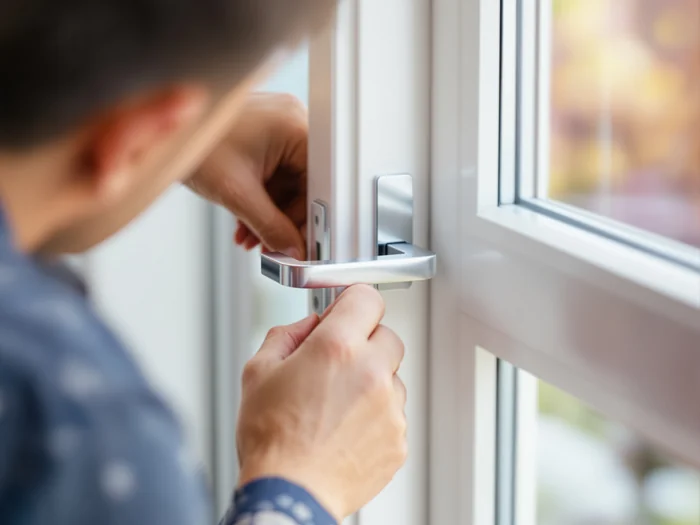
Fitting a new handle — the part you touch every single day
Sliding & Patio Door Handle Replacement
The handle is the part of your sliding or patio door you touch every single time you use it — and over years of daily operation, it is often the first component to show signs of wear. A loose, wobbly handle is annoying. A handle that has snapped off entirely — which happens more often than you might think, particularly on older uPVC patio doors with plastic-bodied handles — makes the door difficult or impossible to operate. A handle that spins without engaging the lock mechanism suggests the problem may run deeper than the handle itself.
Our supply-and-fit handle replacement service covers all sliding and patio door handle types: inline handles, offset locking handles, D-handles, and the various locking and non-locking configurations found across uPVC, aluminium, and timber frames. The specialist brings a selection of matching handles, measures the critical dimensions on your door, and fits the correct replacement — often within 30 minutes.
One of the most valuable things a specialist brings is diagnostic skill. A handle that turns without resistance could be a broken handle spindle, a stripped gearbox, or a detached lock mechanism — three very different problems with different fixes. The specialist will diagnose the exact fault before doing any work.
Handle Replacement Service
Our handle replacement service is designed around speed and accuracy. The specialist arrives with a selection of common handles covering the most popular styles and finishes — white, chrome, satin silver, and gold — across both inline and offset designs. They measure the two critical dimensions on your door: the PZ centre (the distance between the key cylinder centre and the handle spindle centre) and the screw fixing centres (the distance between the two mounting screws). These measurements determine which handles will fit your door.
If the specialist has a matching handle on the van — which is true in the majority of cases — the replacement is completed there and then. If your door requires a less common handle (a particular colour, a discontinued profile, or a proprietary design from a premium door manufacturer), the specialist will identify the exact model, source it, and return to fit it. The fitting itself is usually quick: removing the old handle, inserting the spindle into the new one, securing the fixing screws, and testing the operation. Most handle replacements are completed within 20 to 40 minutes of work time.
Common Handle Problems
Loose or wobbly handle
A handle that has developed play — it wiggles when you grip it — is often caused by the internal spring mechanism weakening or the fixing screws loosening over time. Tightening the screws is the first thing to check, but if the looseness persists, the spring inside the handle backplate has likely failed. Replacement is the fix.
Handle turns but nothing happens
This is a critical diagnostic distinction. If the handle rotates freely without any resistance and the lock bolts do not move, the problem is often the gearbox inside the lock mechanism rather than the handle itself. The gearbox is the component that converts handle rotation into lock bolt movement; when its internal gears strip or break, the handle spins uselessly. In this scenario, replacing the handle alone will not fix the problem — the gearbox needs attention. See our lock replacement page for more detail.
Snapped or broken handle
Older uPVC patio door handles were often made with internal plastic components that become brittle with age and exposure to sunlight. A handle that snaps off at the base — leaving the spindle exposed — is a common failure on doors from the 1990s and 2000s. The replacement handle will be a modern equivalent, typically with metal internal components, and will be considerably more durable than the original.
Stiff or difficult-to-operate handle
If the handle is stiff to lift or turn, the cause could be a dry or worn handle mechanism, but it could also be a lock mechanism that is binding — for example, because the door has dropped and the lock bolts are misaligned with the keeps. The specialist will check both the handle and the lock to determine which is the source of the stiffness.
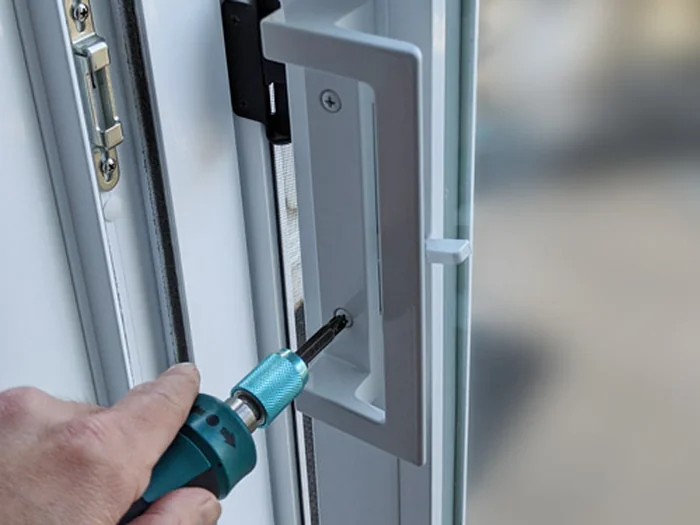
Inline, D-handle, and locking offset lever — the three handle types found on most UK patio doors
Types of Patio & Sliding Door Handles
If you are researching patio door handle replacement options, this guide will help you understand what type you have and what to look for in a replacement.
Inline Handles (Sliding Door)
The long, vertical bar-style handles found on most sliding doors. Inline handles are surface-mounted to the door panel, and the locking mechanism is operated by lifting the handle — which engages the hook bolts — and then turning a separate key or thumbturn. Inline handles are available in locking and non-locking variants, though most external sliding doors use the locking type for security.
Offset/Lever Handles (Patio & French)
The lever-style handle found on patio doors and French doors, usually with a euro cylinder keyhole above or below the lever. Offset handles drive a multipoint lock mechanism via a gearbox, and the key cylinder locks and unlocks the mechanism independently. The backplate (the rectangular plate that sits against the door face) contains the handle spring and fixings.
D-Handles (Older Aluminium)
Shaped like the letter D, these are typically found on older aluminium sliding doors from the 1980s and 1990s. They are usually surface-mounted with visible screw fixings and operate a simpler lock mechanism than modern multipoint systems. Replacement D-handles are available, though matching the exact hole spacing is critical.
Measuring for a Replacement Handle
The two critical measurements are the PZ centre (the distance, in millimetres, from the centre of the key cylinder hole to the centre of the handle spindle hole — typically 92mm on most UK patio doors, but variations exist) and the screw fixing centres (the distance between the two mounting screw holes on the backplate). If you can measure these before contacting us, it helps the specialist bring the right handle. A photo of the existing handle — showing the face and the edge profile — is also useful.
Handle or Lock — Which Is Faulty?
This is the single most important diagnostic question when a patio door will not operate properly, and getting it wrong means paying for the wrong repair. Here is a simple way to think about it: the handle is the thing you grip with your hand. The lock mechanism (which includes the gearbox, the locking bolts, and the keeps) is everything inside the door that the handle drives. If the handle itself is physically broken — snapped, cracked, or so loose it is about to fall off — handle replacement is the fix. If the handle looks fine but the door will not lock, the fault is inside the door, and the lock mechanism or gearbox needs attention.
The grey area is when the handle turns freely without resistance. This can be either a stripped handle spindle (the square bar connecting handle to gearbox) or a stripped gearbox. The specialist diagnoses this by removing the handle, inspecting the spindle, and testing the gearbox directly. If it is the spindle, a new handle (which includes the spindle) solves it. If it is the gearbox, the repair is a lock mechanism repair rather than a handle replacement. We do not charge you for one repair and then reveal you need the other — the diagnosis is part of the visit.
Handle Replacement Near You
If your patio door handle is loose, broken, or no longer engaging the lock, our matching service connects you with a vetted local specialist who can diagnose and fix the problem — often on the same visit. Tell us your postcode and describe what is happening with your door handle, and we will put you in touch with a specialist covering your area.
If the specialist identifies during the visit that the problem is actually the lock mechanism rather than the handle — a common scenario when the handle spins without engaging — they can typically arrange a follow-up visit for the lock repair, or complete it there and then if they carry the necessary lock components on their van.
Frequently Asked Questions
Common questions about this service from UK homeowners.
Available Across the UK
Our network of independent specialists covers 14 major UK cities and their surrounding areas — from Glasgow to Brighton, Cardiff to Newcastle.
In London? Visit our dedicated London specialists at sliding-door-repair-london.uk
Get Your Door Handle Replaced
Supply-and-fit handle replacement from vetted local specialists — free quotes, same-visit in most cases.